RAPIDS SVR and SVC: fast training without fine-tuning, evaluated on MARC-ja
I learned about RAPIDS SVR and SVC in the Kaggle competition Feedback Prize - English Language Learning. They train quickly, and I felt they were useful methods for regression and classification tasks, so I will introduce what they are. In fact, top solutions in that competition used RAPIDS SVR.
I will also use RAPIDS SVC to evaluate MARC-ja, the classification dataset in the Japanese evaluation benchmark JGLUE. The implementation used for the evaluation is available on GitHub.
SVR is Support Vector Regression, and SVC is Support Vector Classification. The algorithm behind them is SVM, or Support Vector Machine, which is known for strong accuracy and was apparently very popular at one point. sklearn also has an implementation, so many people have probably used it.
The implementation is based on libsvm. The fit time complexity is more than quadratic with the number of samples which makes it hard to scale to datasets with more than a couple of 10000 samples.
In other words, with sklearn's libsvm-based implementation, scaling past around ten thousand samples is not very realistic.
What are RAPIDS SVR and SVC?
RAPIDS SVR and SVC are SVM implementations in cuML, which is part of RAPIDS, NVIDIA's project for GPU-accelerated data science. Roughly speaking, cuML implements general-purpose machine learning algorithms similar to those in sklearn, follows sklearn's estimator API such as fit() and transform(), and optimizes them to run on CUDA. According to its benchmarks, it is 10 to 50 times faster than sklearn. That means algorithms that are difficult to run at practical speed in sklearn can become practical with cuML. RAPIDS also includes other CUDA-based tools, such as cuDF for fast DataFrame operations, so it is worth looking at the rest of the project if you are interested.
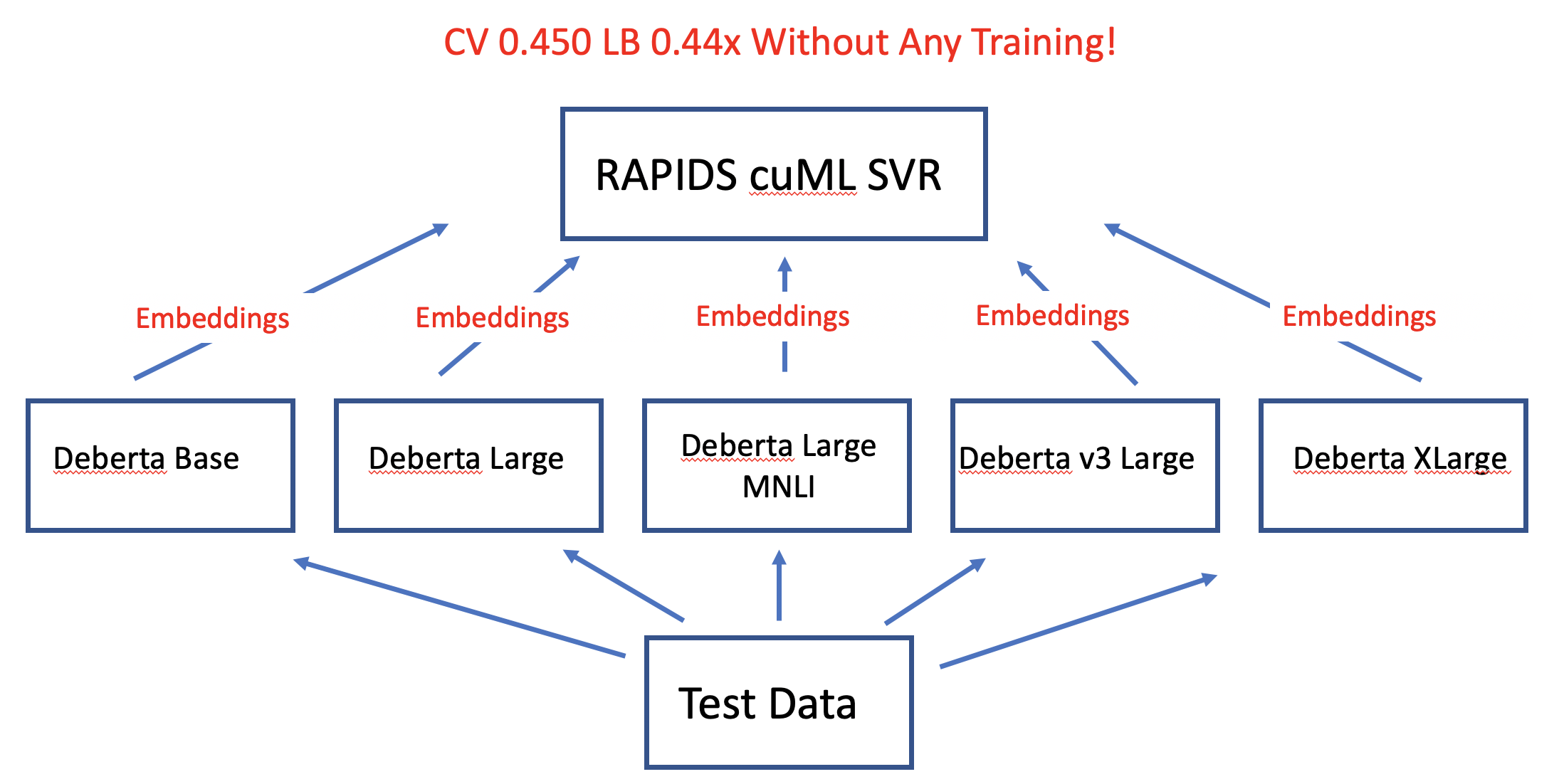
What becomes useful when SVR can run quickly? One answer is that training on the embedding representation from a neural network output layer becomes practical. You can take an existing public model, use it only for feature extraction without fine-tuning, and train SVR on those features. It is also easy to combine features from multiple models and train on the concatenated features. You can use non-fine-tuned models this way, but fine-tuned models can also be used as feature extractors.
How should we extract features from a neural network? As an example, I will describe encoder models from Hugging Face Transformers. For most encoder models, you can either take the CLS token from last_hidden_state or apply mean pooling. The resulting vectors are then normalized before use.
After that, we only need to train with SVC. SVR works with almost the same code.
from cuml.svm import SVC
import numpy as np

DEFAULT_SVC_PARAMS = {
    "C": 3.0,  # Penalty parameter C of the error term.
    "kernel": "rbf",  # Possible options: ‘linear’, ‘poly’, ‘rbf’, ‘sigmoid’.
    "degree": 3,
    "gamma": "scale",  # auto or scale
    "coef0": 0.0,
    "tol": 0.001,  # 0.001 = 1e-3
}

def train_svc(
    X: np.ndarray,
    y: np.ndarray,
    svc_params: dict[str, object] = DEFAULT_SVC_PARAMS,
    probability: bool = True,
) -> SVC:
    svc = SVC(**svc_params)
    svc.probability = probability
    svc.fit(X, y)
    return svc
The core is almost just this.
Measuring the score on MARC-ja
Now let's evaluate MARC-ja, the classification dataset in the Japanese evaluation benchmark JGLUE. MARC-ja is a binary positive/negative sentiment classification dataset built from Japanese Amazon reviews. It has 187,528 train samples and 5,654 dev, or validation, samples. That is a reasonably large dataset. The test data does not seem to be publicly available at the moment.
JGLUE's GitHub page lists dev accuracy scores. For example, cl-tohoku/bert-base-japanese-v2 gets 0.958 after four epochs. The top score shown there is 0.964 from XLM-RoBERTa large.
Training time is also interesting. When I ran training casually on Colab with a T4 GPU, one epoch of bert-base-japanese-v2 took about 100 minutes, with 0.9573 accuracy after the first epoch. On my local RTX 4090, one epoch took about 30 minutes.
In the repository above, I implemented feature extraction from a neural network on MARC-ja and training with RAPIDS SVC. Let's first train and evaluate SVC using cl-tohoku/bert-base-japanese-v2 without fine-tuning. The execution times below are from my local RTX 4090.
Feature extraction took 394 seconds, SVC training took about 18 seconds, and the accuracy was 0.92766. Once features are extracted, my implementation reuses them as a cache, so the second run costs almost only the SVC training time.
Next, let's look at the same model with mean pooling instead of CLS.
I had already run this before, so the features were loaded from cache and only SVC training was needed. Accuracy was 0.93244, so mean pooling worked better than CLS. What happens if we train on both sets of features?
Because both feature sets were already cached, loading was almost instant, and SVC training took about 30 seconds. The result was 0.93350. Even with the same neural network model, extracting CLS and mean-pooled features separately and training on them together improved the score by about 0.001.
How about classic TF-IDF? TF-IDF features have too many dimensions as-is, so I reduced them to 1000 dimensions with SVD and then trained and evaluated SVC.
Accuracy was 0.89247, which is not very good. For text with many unseen words, this is probably about what we should expect. Then what happens if we combine TF-IDF with BERT features?
The result was 0.93792, much higher than BERT alone. TF-IDF points in a different direction as a feature source, so combining it likely added diversity and improved the score. It is also interesting that SVC training became slightly faster than TF-IDF alone, perhaps because convergence was better.
In the same way, I tried combining features from several Japanese models published on Hugging Face.
Training SVC on 187528x5608 features took 90 seconds. The accuracy was 0.94323, the best result in this trial. Compared with the 0.958 score from properly fine-tuned BERT, it is still not enough. Still, it is good enough to consider as one model in an ensemble, and there is still plenty of room to improve the score by adding more features.
The training speed is high. Once the neural network features, which take the most time, have been extracted, I can freely combine features and observe results. That also means using a large number of folds should still be practical.
Use in real Kaggle competitions
In the competition I recently joined, Feedback Prize - English Language Learning, which predicted scores for text, the summary of the 1st through 8th place solutions says that the 1st, 3rd, and 4th place solutions used RAPIDS SVR models in their ensembles. I also tried SVR. Because it did not improve my Public LB score when added to my ensemble, I did not include it in my final submission. However, it scored higher on both Public and Private LB than the early public fine-tuned DeBERTa v3 base model. After the competition ended, I was able to confirm on the Private LB that adding it to the ensemble improved the score, so knowing the result now, I should have included it.
Another possible use is near the end of a competition, when deciding which additional models to include in an ensemble. It may be useful to first pass candidate model features through SVR and prioritize fine-tuning the models with higher scores. Pretrained Embeddings are all you need (sort of ...) lists SVR results for extracted features, and I think the scores would correlate with the scores obtained by actually fine-tuning those models.
Closing
This article introduced RAPIDS SVR and SVC, which can train directly on extracted features without fine-tuning. Fine-tuning often takes tens of minutes to several hours depending on the amount of data, and real-world datasets can be much larger. SVR and SVC, which can run in a "RAPID" way with a few minutes for feature extraction and seconds to tens of seconds for training, seem useful not only for Kaggle but also for ordinary work and research.
Until now, when I did not train a neural network for regression or classification tasks, I usually only tried gradient boosted decision trees. RAPIDS SVR and SVC make it possible to run SVM quickly, so they look like methods worth adding to the list of things to try.